Welcome to the "House" Side of the Table
Most retail traders treat the stock market like a casino. They buy call options hoping for a massive jackpot, and usually, their tickets expire worthless. They are the gamblers.
At Trade to Freedom, we don’t gamble. We operate the casino.
Selling put options is the cornerstone strategy for traders who want steady, reliable cash flow rather than adrenaline-fueled guesswork.
The promise of this guide is simple: We are going to show you how to get paid cash today for the mere promise of buying a stock you already like at a discount tomorrow.
It sounds too good to be true, but it is the bread-and-butter strategy of professional income traders. If you have cash sitting in your brokerage account doing nothing, you are leaving money on the table every single week.
Let's unlock that potential.
What Actually Is Selling a Put?
Forget the complex Greeks for a moment. Let’s look at the "Plain English" version of this trade.
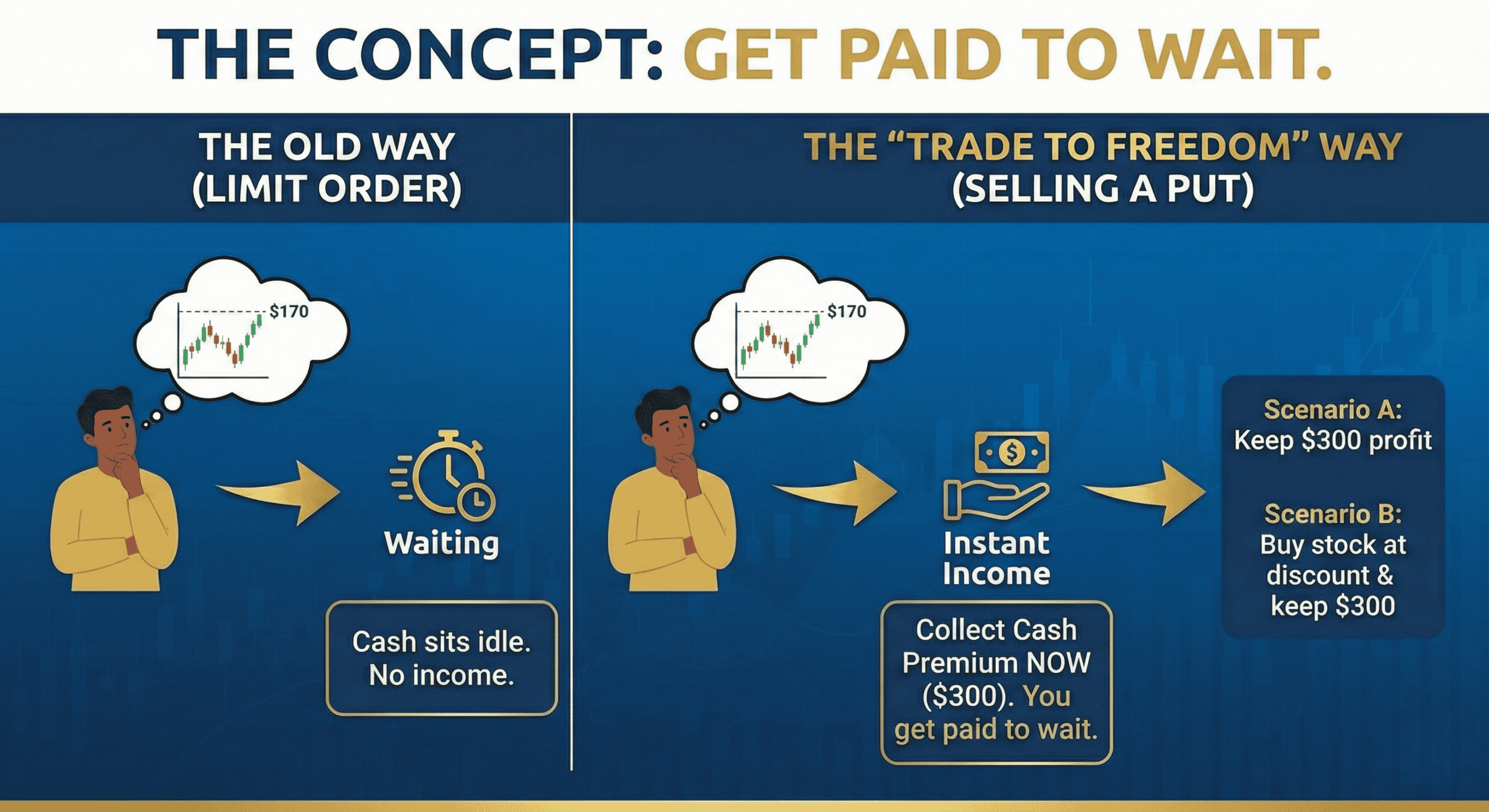
Imagine you want to buy 100 shares of a stock (let's use AMD as an example). It’s currently trading at $180, but you only want to buy it if it dips to $170.
The Old Way: You set a "Limit Order" to buy at $170 and you wait. If it never drops to $170, you never buy the stock. Your cash sits there, earning nothing.
The "Trade to Freedom" Way (Selling a Put): You tell the market: "I promise to buy 100 shares of AMD at $170 anytime in the next 30 days."
Because you took on that obligation, another trader pays you cash instantly. Let's say they pay you $300.
That $300 is yours to keep no matter what happens.
There are only two outcomes, and both are good:
-
Scenario A: The stock stays above $170. The option expires. You don't buy the stock. You keep the $300 profit. (That’s a "Freedom Income" trade).
-
Scenario B: The stock drops below $170. You are forced to buy the stock at $170. But remember, you wanted the stock at $170 anyway. Plus, you still keep the $300 premium, meaning your actual cost basis is $167.
Selling Puts = Getting paid to set a limit order on stocks you love.
The Trade to Freedom Selection Criteria
You don't just sell puts on anything that moves. That’s how you blow up an account. We use strict criteria to ensure we are trading safely.
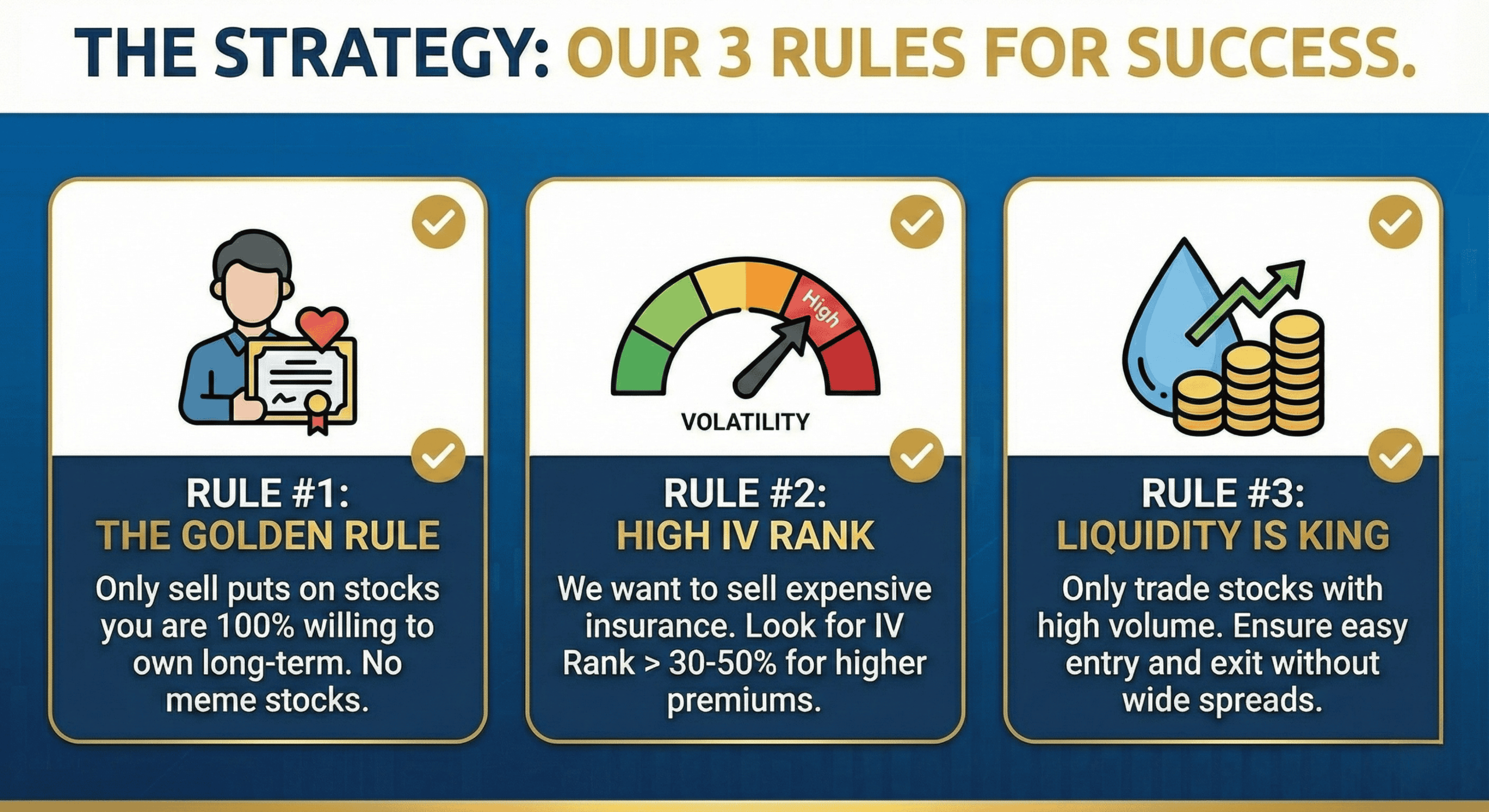
Rule #1: The "Golden Rule" Only sell puts on stocks you are 100% willing to own long-term. If you wouldn't buy the stock and hold it for a year, do not sell a put on it. This is not for meme stocks that might go to zero next week. Think blue chips, solid ETFs, and quality growth companies.
Rule #2: High Implied Volatility (IV) Rank We want to sell expensive insurance, not cheap insurance. When market fear is high, option premiums become expensive. We look for stocks with an IV Rank over 30-50%. This means we get paid more for taking the same amount of risk.
Rule #3: Liquidity is King Only trade stocks with high option volume. You need to be able to enter and exit trades instantly without giving up money to wide bid/ask spreads.
Finding The "Sweet Spot" Strike Price
How do you choose which put to sell? We balance probability with profit.
If you sell a strike too close to the current price, you risk getting assigned the stock too easily. If you sell too far away, you collect pennies.
The Sweet Spot: The .15 - .30 Delta
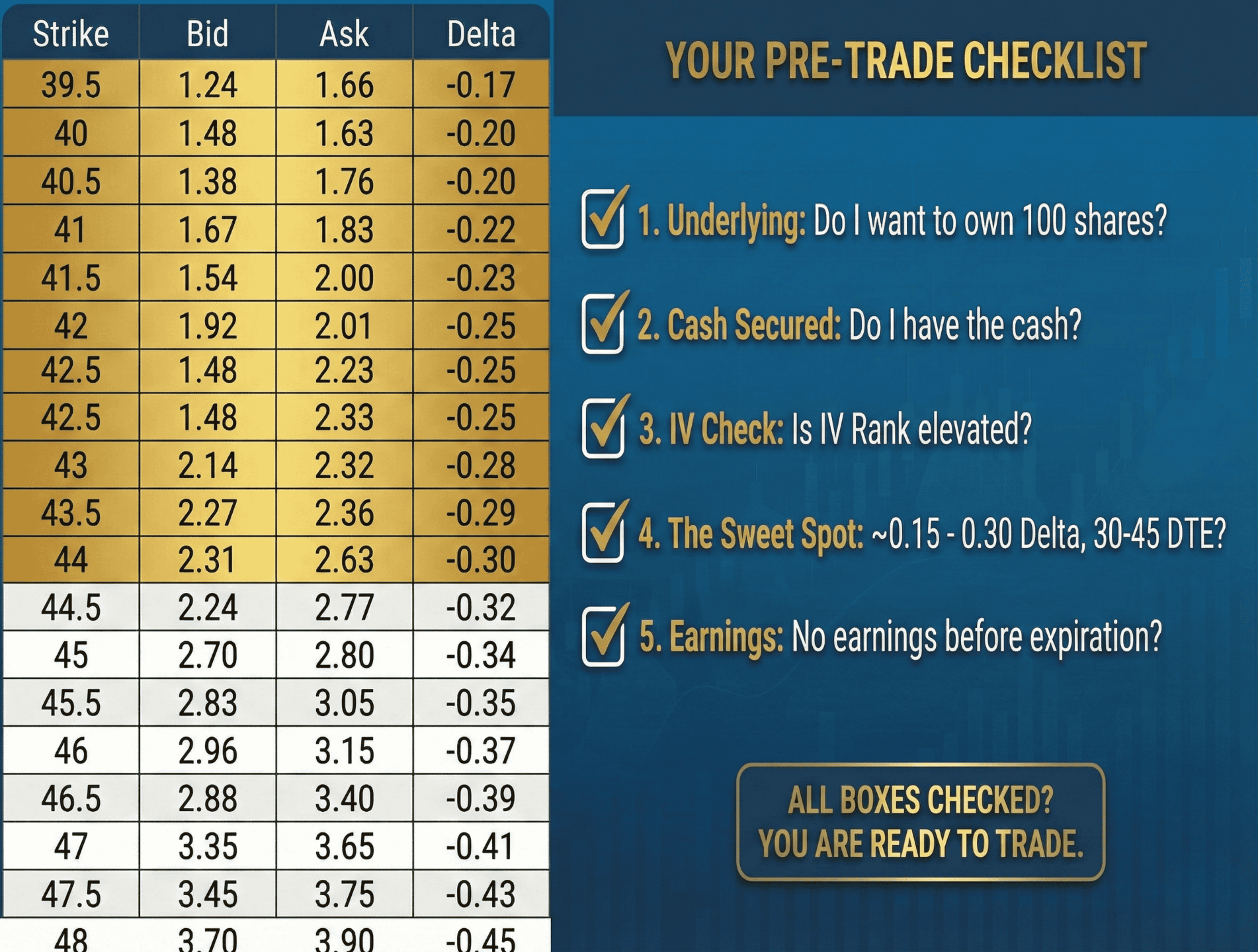
Look at the option chain's "Delta" column. We generally look to sell puts around the 0.15 - 0.30 Delta.
-
This roughly translates to a 70% - 85% statistical probability that your option will expire worthless (meaning you keep 100% of the profit without buying the stock).
-
It offers a healthy premium payment while keeping a safe distance from the current stock price.
Timeframe: 30–45 Days to Expiration (DTE) Don't sell weekly options (too much gamma risk). Don't sell 6-month options (too slow). The 30-45 day window is where "Theta" (time decay) eats away at the option's value the fastest. This works in your favor as a seller.
The Payday: What Do These Numbers Actually Mean?
Look at the 44 Strike highlighted in gold above. You see a Bid/Ask around 2.31.
New traders see "2.31" and think it's pocket change. Pros see a 5% return in one month.
Here is the math of that trade:
-
The Multiplier: Option contracts represent 100 shares. So, a price of $2.31 actually means $231.00 in instant cash straight into your account for every single contract you sell.
-
The ROI (Return on Investment): To sell this put, you need $4,400 of cash collateral (Strike 44 x 100).
-
You are getting paid $231 to secure $4,400.
-
$231 / $4,400 = 5.25% Return.
-
Think about that. A high-yield savings account takes an entire year to pay you 5%. By selling this one put option in the "Sweet Spot," you just generated a 5.25% return in less than 45 days.
And the best part? You get paid that money today.
The "Sell to Open" Checklist
Before you enter the trade, check these 5 boxes:
-
1. The Underlying: Do I actually want to own 100 shares of this stock at the strike price? (If No, STOP).
-
2. Cash Secured: Do I have the cash in my account to buy the shares if assigned? (e.g., selling a $50 strike put requires $5,000 cash available).
-
3. IV Check: Is the IV elevated (ideally >30%+) so I am getting paid a premium price?
-
4. The Sweet Spot: Am I selling near the 15-30 Delta, 30-45 days out in time?
-
5. Earnings: Are there earnings reports between now and expiration? (We usually avoid selling puts over earnings events due to unpredictability).
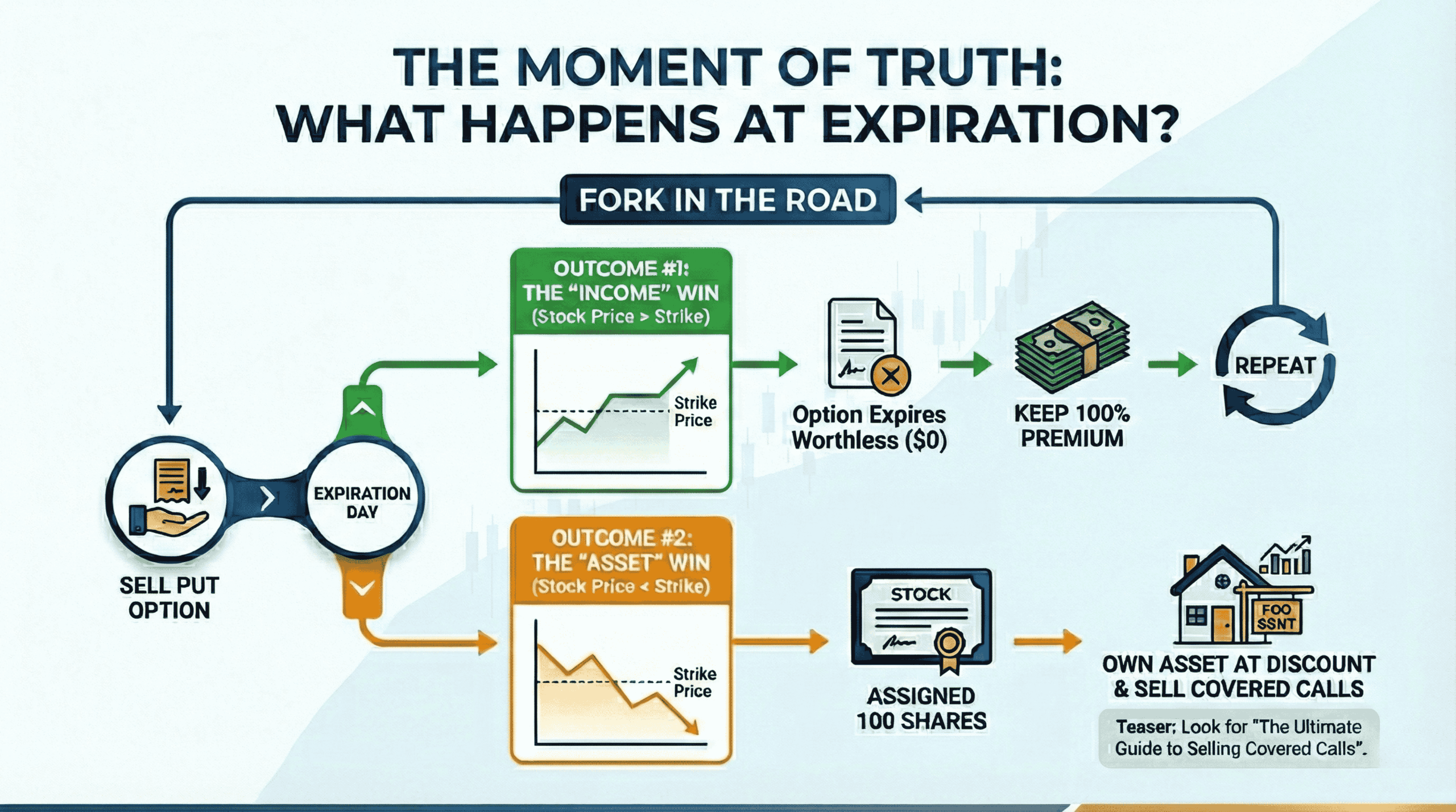
The Moment of Truth: What Happens at Expiration?
Once you have sold the put, you simply let time do the work. As expiration approaches, there are only two roads this trade can take. Because we chose a quality stock, both roads lead to opportunity.
Outcome #1: The "Income" Win (Stock Price > Strike Price)
-
The Scenario: The stock stays flat or goes up. It finishes above your strike price on expiration day.
-
The Result: The option expires worthless (value = $0).
-
The Win: You keep 100% of the cash premium you collected upfront. The contract disappears from your account, and your cash collateral is unlocked.
-
Your Move: You celebrate the income, and on Monday, you find a new setup to sell another put. This is how we generate weekly cash flow.
Outcome #2: The "Asset" Win (Stock Price < Strike Price)
-
The Scenario: The stock price dips below your strike price.
-
The Result: You are "assigned" the shares. Your cash collateral is used to automatically buy 100 shares of the stock at your agreed strike price.
-
The Win: You now own a high-quality asset at a discount (the strike price minus the premium you received).
-
Your Move: Don't panic—this is part of the plan! Now that you own the shares, you can switch strategies. You can now sell Covered Calls against these shares to collect even more premium while waiting for the stock to rebound.
"What is a Covered Call?" Selling Covered Calls is how we turn our stocks into "rental properties" that pay us rent every week. It is the second half of the "Freedom Wheel" strategy.
However, mastering the Covered Call is a powerful skill that deserves its own manual. Keep an eye out for our upcoming release: "The Ultimate Guide to Selling Covered Calls."
Your Path to Trading to Freedom Starts Here
Selling puts changes your relationship with the market. You stop frantically chasing green candles and start strategically collecting income.
It’s not about hitting home runs; it’s about hitting consistent singles and doubles that compound your wealth over time.
Ready to see this in action?
This guide gave you the "what" and the "why." The Trade to Freedom mentorship program shows you the "how," in the markets every day.
If you want to see exactly which puts I am selling right now, join our community.
DISCLAIMER: This guide is for educational purposes only and does not constitute financial advice. Money Talk w/ Rashad and Trade to Freedom are not registered financial advisors. Options trading involves significant risk and is not suitable for all investors; you may lose more than your initial investment. Past performance is not indicative of future results. Please consult a qualified professional before trading.