The "Stock Replacement" Cheat Code
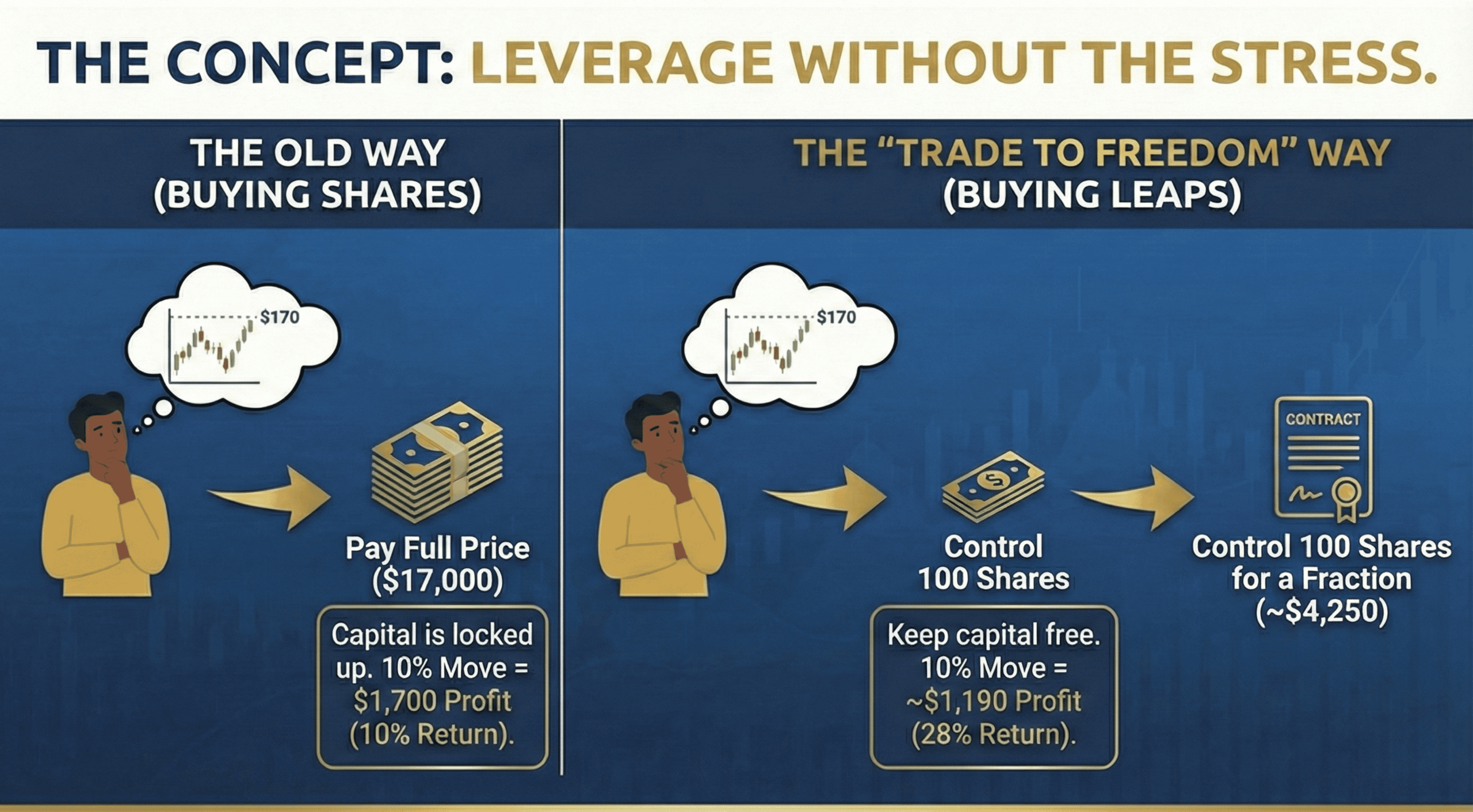
Many traders think the only way to build wealth is to buy 100 shares of a stock. But what if you want to own Broadcom (AVGO) or Booking Holdings (BKNG)? You might need $10,000, $50,000, or even $100,000 just to enter the trade.
That is the old way.
At Trade to Freedom, we use a tool called LEAPS (Long-Term Equity Anticipation Securities).
Buying a LEAP option allows you to control 100 shares of a massive company for a fraction of the price (often 75% less capital required), while still capturing the majority of the stock's upside.
This guide isn't about day-trading penny stocks. It's about acting like a hedge fund: identifying powerful, dominant companies and using leverage responsibly to compound your account.
Rule #1 - We Only Trade Giants
The first rule of buying LEAPS is safety. Because we are holding these contracts for a long time (12+ months), we need to know the company isn't going bankrupt.
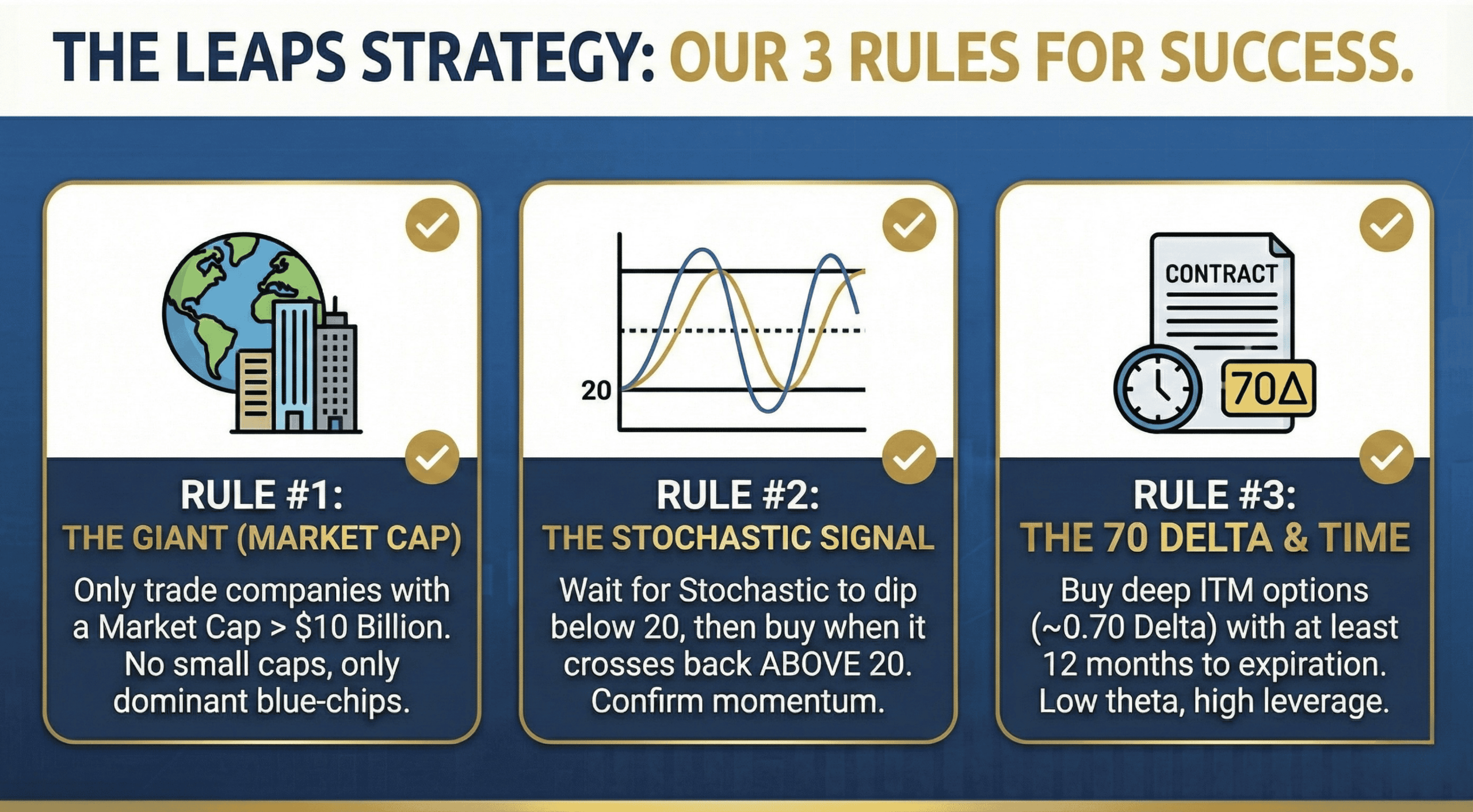
The "Trade to Freedom" Market Cap Rule: We NEVER buy LEAPS on small companies. Small caps are too volatile and risky for this strategy.
The Criteria: $10 Billion Minimum We only trade companies with a Market Cap of $10 Billion or higher.
-
We want household names.
-
We want institutional favorites (stocks that banks and hedge funds are buying).
-
We need high liquidity so we can get in and out of the trade easily.
If it’s not a Giant, we don’t touch it.
Rule #2 - The "Stochastic Pop" Entry
Even with a great company, you can lose money if you buy at the top. We need a signal that tells us the stock is cheap and ready to run.
The Tool: The Stochastic Oscillator We use the Weekly Stochastic indicator to identify when a stock has been "beaten down" unfairly.
The Setup:
-
Oversold Territory: We wait for the Stochastic lines to drop below 20 (the "Oversold" zone). This tells us the sellers are exhausted.
-
The Trigger: We DO NOT buy while it is still falling. We wait for the Stochastic to curl up and cross back ABOVE the 20 line.
Why wait for the cross above 20? Crossing above 20 confirms that momentum has shifted. The buyers have stepped back in, and the trend is reversing upward. That is our green light.
Rule #3 - The "70 Delta" Sweet Spot
Now that we have the right stock and the right timing, which option do we buy?
Most amateurs buy "Out of the Money" options because they are cheap. That is a mistake. They decay too fast and act like lottery tickets.
We Buy "Deep In The Money" (ITM) We look for a Delta of 0.70.
Why the 70 Delta?
-
High Correlation: A 0.70 Delta means that for every $1.00 the stock price goes up, your option increases by $0.70. You are getting 70% of the stock's move, but you are putting up significantly less cash.
-
Less Time Decay: Deep ITM options suffer much less from "Theta" (time decay) than cheap OTM options.
-
Safety: Because the strike price is far below the current stock price, the stock can pull back slightly, and your trade will still be alive.
Expiration Date: Always buy time. Look for expiration dates at least 12 months out. We want to give the trade plenty of room to work.
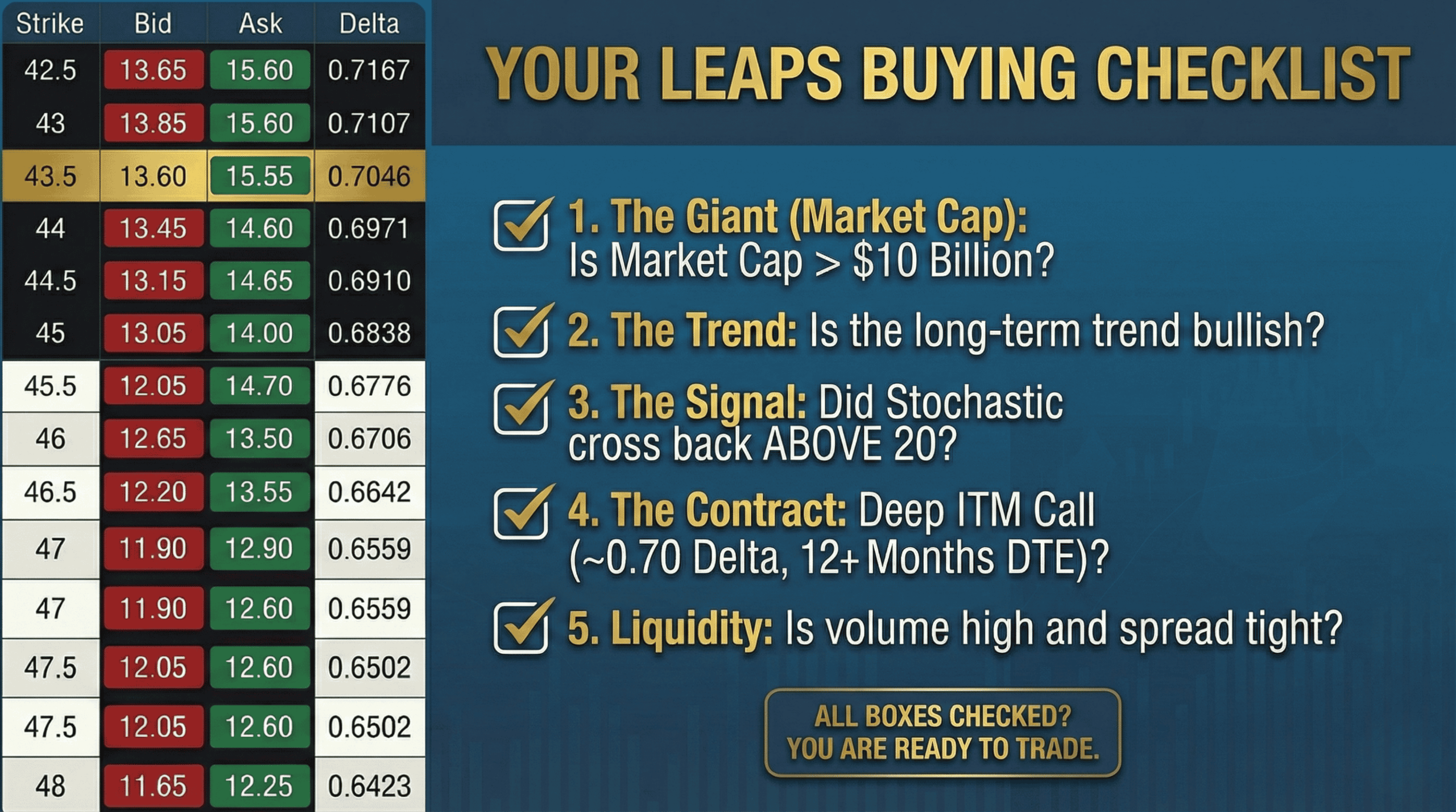
The Numbers: Why We Don't Buy The Stock
Look at the 43.5 Strike in the image above. You see a Delta of 0.70 (technically 0.7046) and an Ask price of 15.55.
New traders look at the stock price and think they can't afford to play. Pros use LEAPS to enter the game for a discount.
Here is the math of that trade on this "Tech Giant":
-
The Old Way (Buying Shares): To buy 100 shares of this stock at the current stock price of $48.47, you would need to write a check for $4,847.00.
-
Capital Locked Up: $4,847
-
-
The "Trade to Freedom" Way (Buying the LEAP): Instead, you buy the 43.5 Strike Call for $15.55. Since options represent 100 shares ($15.55 x 100), you control the same 100 shares for just $1,555.00.
-
Capital Locked Up: $1,555
-
The Result? You control the exact same asset, but you kept $3,292 in your pocket. You are getting all the exposure for one-third of the cost.
The "Pop": How Leverage Supercharges Your Returns
This is where the 0.70 Delta makes you rich.
If the stock price goes up by $5.00 (a ~10% move):
-
The Stock Owner: Makes $500 profit on a $4,847 investment = 10.3% Return.
-
The LEAPS Owner: Makes ~$350 profit ($5.00 x 0.70 Delta x 100) on a $1,555 investment = 22.5% Return.
Same stock move. More than DOUBLE the profit percentage. This is how we grow small accounts into large ones without risking everything we have.
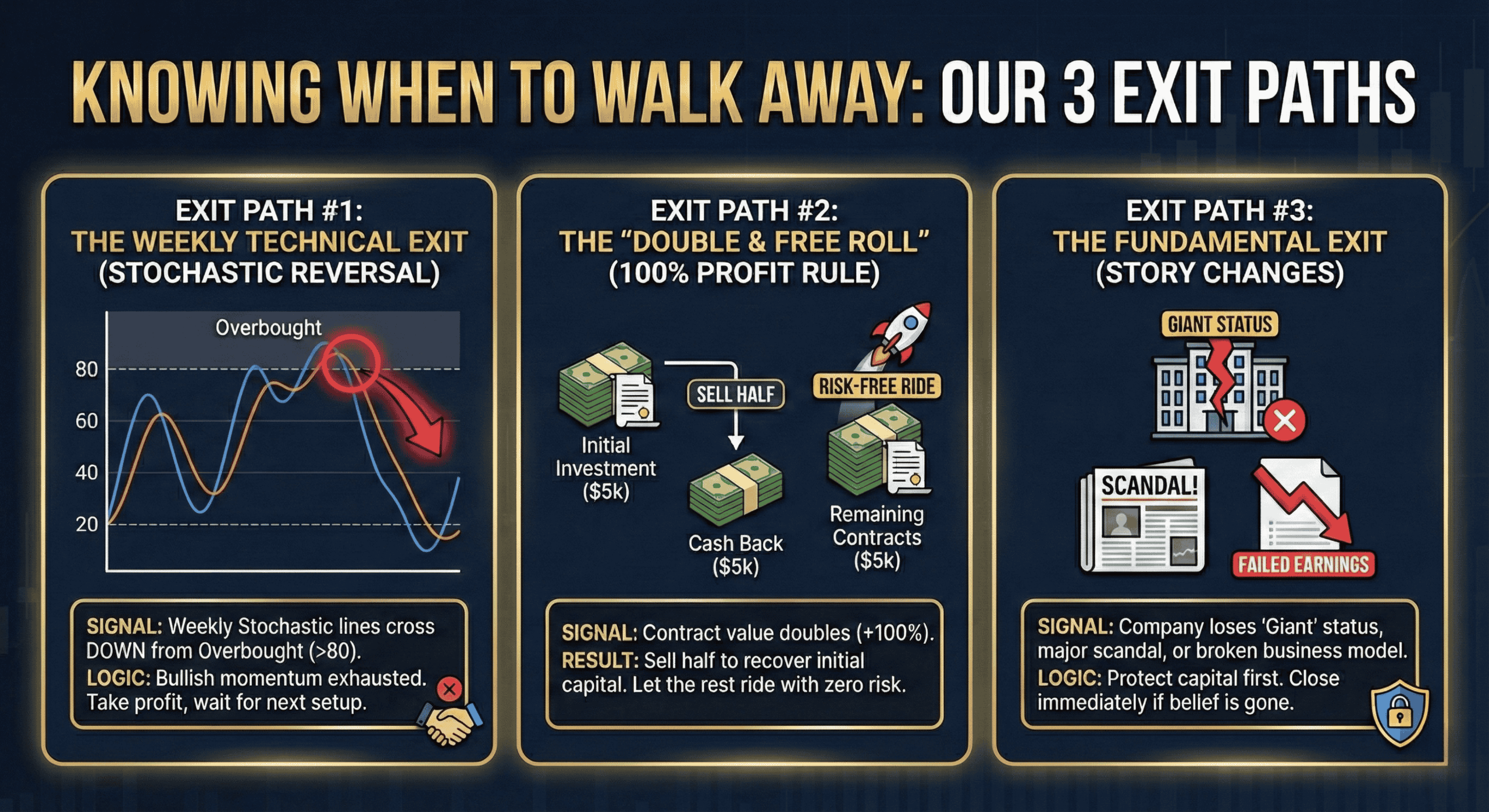
Knowing When to Walk Away
Buying the LEAP is only half the battle. The market is littered with traders who saw a 50% gain evaporate because they didn’t know when to sell.
At Trade to Freedom, we don't guess. We use three clear "Exit Paths." Choose the one that fits your trading style.
Exit Path #1: The Technical Exit (Stochastic Reversal) We used the Stochastic to get in (crossing up), so we can use it to get out.
-
The Signal: Watch for the Stochastic lines to enter "Overbought" territory (above 80) and then curl back DOWN.
-
The Logic: This signals that the immediate bullish momentum is exhausted. If the lines cross down, the easy money has been made. Take your profit and wait for the next setup.
Exit Path #2: The "Double & Free Roll" (100% Profit Rule) This is the psychological favorite.
-
The Signal: Your contract value doubles (increases by 100%).
-
The Logic: If you bought a contract for $5.00 and it hits $10.00, you can sell half of your position.
-
The Result: You have your original investment back in your pocket. The remaining contracts are now "Risk-Free." You can let them ride to the moon with zero stress.
Exit Path #3: The Fundamental Exit Sometimes, the story changes.
-
The Signal: The company loses its "Giant" status. Maybe there is a massive scandal, a failed earnings report that breaks the business model, or a change in leadership.
-
The Logic: We only trade companies we believe in. If you no longer believe the company is a dominant force, close the trade immediately. Do not hope it comes back. We protect our capital first.
The LEAPS Buying Checklist
Before you enter the trade, check these 5 boxes:
-
1. The Giant: Is the company's Market Cap > $10 Billion? (No small caps allowed).
-
2. The Trend: Is the long-term trend of the company up? (Don't fight a dying business).
-
3. The Signal: Did the Stochastic indicator dip below 20 and then cross back UP above 20? (Momentum shift confirmed).
-
4. The Contract: Am I buying a contract with a ~0.70 Delta that expires in 12+ months?
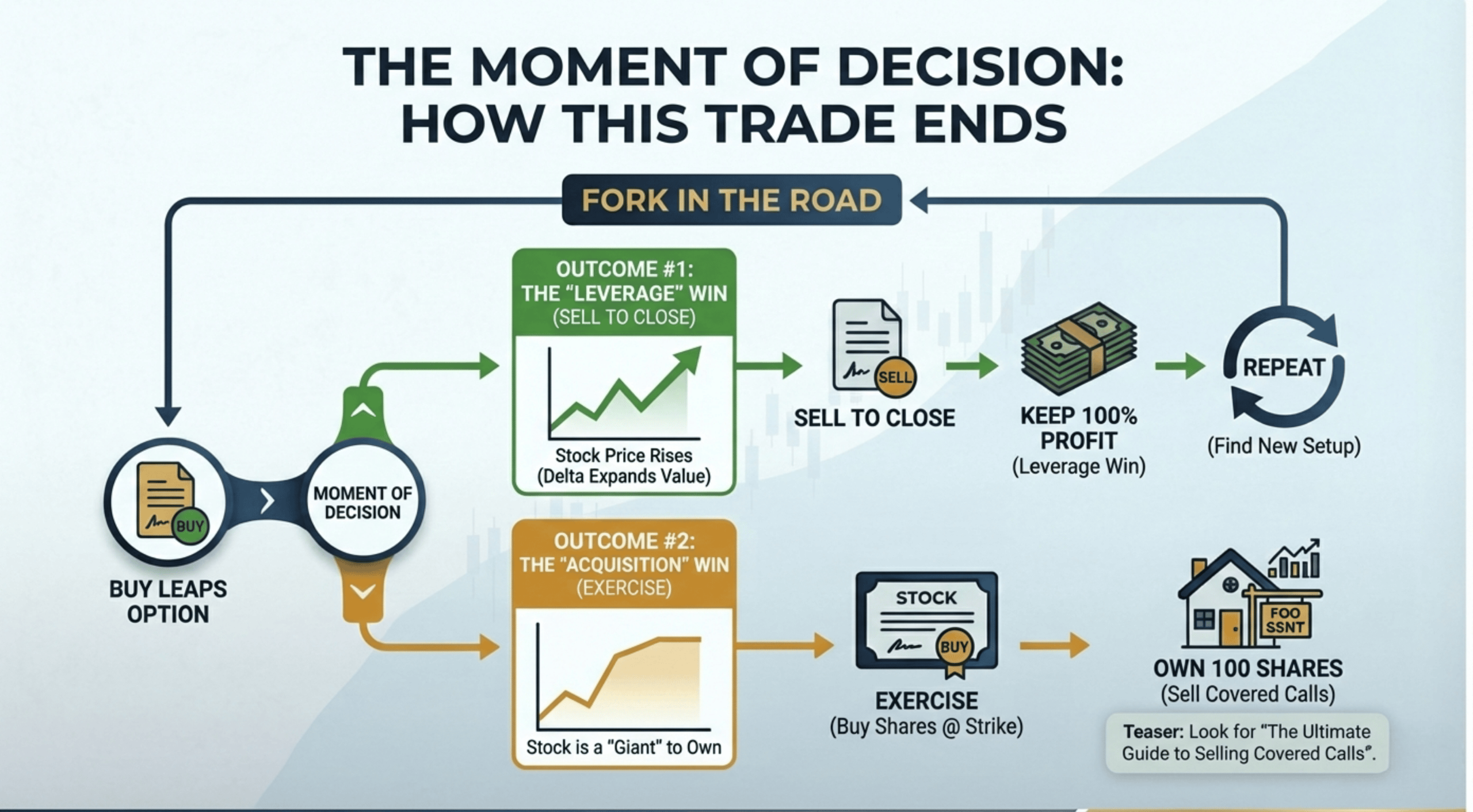
The Moment of Truth: What Happens at Expiration?
Once you have bought the LEAP, you hold the power. You control 100 shares of a "Giant" without having paid full price. As the stock price moves, you have two powerful roads to take.
Outcome #1: The "Leverage" Win (Sell to Close)
-
The Scenario: The stock price rises as predicted. Because you bought a 70 Delta, your option contract gains value rapidly.
-
The Result: You simply sell the option contract back to the market (Sell to Close). You never touch the actual shares.
-
The Win: You pocket the difference between what you paid and the new, higher value. Because of leverage, a 10% move in the stock might result in a 20%, 50%, or 100% gain in your option contract.
-
Your Move: You take the cash profit, celebrate the win, and use the funds to hunt for the next "Stochastic Pop" setup. This is how we grow a small account into a large one.
Outcome #2: The "Acquisition" Win (Exercise the Option)
-
The Scenario: The stock has gone up significantly, and you decide you want to own this company forever (perhaps for dividends or long-term growth).
-
The Result: You choose to "Exercise" your option. You pay the Strike Price × 100 to officially buy the shares.
-
The Win: You acquire 100 shares of a massive company at a deep discount (your Strike Price) compared to the current market value.
-
Your Move: You now own 100 shares of a Giant. Now that the shares are in your name, you can switch strategies. You can now sell Covered Calls against these shares to collect monthly income while you hold them.
"What is a Covered Call?" Selling Covered Calls is how we turn our stocks into "rental properties" that pay us rent every week. It is the perfect next step after acquiring shares through a LEAP.
However, mastering the Covered Call is a powerful skill that deserves its own manual. Keep an eye out for our upcoming release: "The Ultimate Guide to Selling Covered Calls."
Leverage Without The Stress
Buying LEAPS is the perfect middle ground between the safety of stock investing and the power of options trading.
By following the Trade to Freedom rules—sticking to $10B+ Giants, waiting for the Stochastic confirmation, and buying the 70 Delta—you are positioning yourself to win.
Want to see us trade these live?
In the Trade to Freedom community, we call out these setups in real-time. We scan the market for the Giants that are crossing the 20 line, and we trade them together.
Your Path to Trading to Freedom Starts Here
Buying LEAPS changes your relationship with the market. You stop gambling on short-term "lotto tickets" that expire worthless and start controlling the world's best companies for pennies on the dollar.
It’s not about frantic day trading; it’s about patient, calculated leverage. You are positioning yourself to capture massive stock moves without tying up your entire account.
Ready to see this in action?
This guide gave you the "what" and the "why." The Trade to Freedom mentorship program shows you the "how," live in the markets every day.
If you want to see exactly which Giants I am buying LEAPS on right now, join our community.
DISCLAIMER: This guide is for educational purposes only and does not constitute financial advice. Money Talk w/ Rashad and Trade to Freedom are not registered financial advisors. Options trading involves significant risk and is not suitable for all investors; you may lose more than your initial investment. Past performance is not indicative of future results. Please consult a qualified professional before trading.